
Castle Bromwich Junior School

English
English at CBJS
At our school, the English curriculum aims to develop confident, creative, and enthusiastic communicators. Through reading, writing, speaking and listening, pupils learn to express their ideas clearly, understand others, and enjoy the richness of language. We aim to foster a lifelong love of reading and help children build strong foundations for future learning.
Curriculum Overview
English is taught daily and integrated across the wider curriculum. Lessons are engaging, age-appropriate, and designed to meet the needs of all learners. Pupils explore a wide range of texts, including: stories, poems and non-fiction, while developing essential skills for writing.
Our curriculum focuses on:
- Develop confident reading skills, including: phonics, fluency, and comprehension;
- Build clear and creative writing, using correct grammar, spelling, and punctuation;
- Strengthen speaking and listening for effective communication and discussion;
- Expand vocabulary and understanding of how language works;
- Foster confidence, creativity, and enjoyment of reading and writing;
Children are exposed to a wide variety of texts.
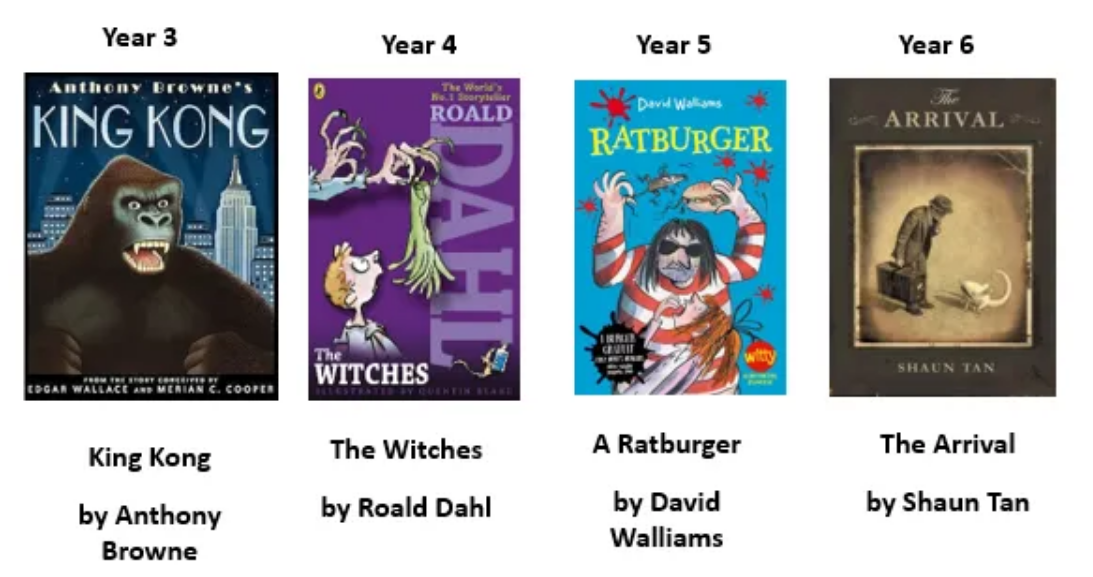
The texts currently being studied are:
Areas of Learning
Reading
Pupils are encouraged to become confident and fluent readers. They develop:
- Phonics and word recognition skills;
- Reading fluency and expression;
- Comprehension skills, such as: predicting, questioning, and summarising;
- A love of books through Shared reading, library visits and independent reading.
Children are exposed to a wide variety of texts.
Writing
Writing lessons help pupils express ideas clearly and creatively. Children learn to:
- Write for different purposes and audiences;
- Use correct spelling, grammar, and punctuation;
- Plan, draft, edit, and improve their work;
- Develop handwriting and presentation skills.
Pupils write stories, poems, reports, letters, and other meaningful texts.
Speaking and Listening
Oral communication is an important part of English learning. Pupils are taught to:
- Speak clearly and confidently in front of others;
- Listen attentively and respond appropriately;
- Participate in discussions, role-play, and drama activities;
- Build vocabulary and language confidence.
Our Intent and Implementation & Teaching and Learning Approaches
Reading
Reading Vision
At CBJS, we believe reading opens the door to knowledge, imagination, and curiosity. We aim to develop confident, enthusiastic readers who enjoy a wide range of texts, build strong comprehension and vocabulary, and see themselves as lifelong readers capable of exploring ideas and perspectives.
Teaching and Learning Approaches to Reading
To teach reading, we use Shared Reading, where a shared text is read with the whole class. The text chosen is a quality text with rich content but also chosen for enjoyment.
Over the course of a week, children will have the experience of: a decoding session (lower school) or vocabulary session (upper school), a “Book Talk” session and will be taught a minimum of one reading skill, followed by an opportunity to independently apply this skill to a comprehension activity.
Intent
- Promoting a Love of Reading: We aim to inspire a passion for reading by introducing pupils to a broad range of texts, genres, and authors, encouraging reading for pleasure and celebrating the joy of discovering new worlds through books.
- Language Development: Our curriculum supports the development of a wide and varied vocabulary, enabling children to express themselves with clarity and precision. Reading lessons provide regular exposure to key words, helping pupils retain and apply new vocabulary in both spoken and written contexts.
- Fluency: We place a strong emphasis on reading fluency, supporting accuracy, automaticity, and expressive reading. By reducing cognitive load through automatic recognition of words, children can focus on expression, intonation, and phrasing, enhancing comprehension and engagement with texts.
- Comprehension: We nurture the skills and habits required for children to become thoughtful, discerning readers. Through coverage of all reading domains and a focus on questioning texts during and after reading, pupils learn to analyse meaning, make connections, and engage critically with a range of texts.
- Inclusivity: Our reading curriculum is designed to meet the needs of all learners, including those with SEND and disadvantaged pupils. Where needed, instruction is adapted and targeted support provided to ensure every child makes progress.
- Assessment and Progress Monitoring: At CBJS, we use a range of assessment tools to gain a full picture of each child as a reader. Standardised measures, including reading tests and statutory assessments, provide additional insights, while termly MAT moderation ensures consistency and quality in assessment judgements.
- Continuous Curriculum Development: Our reading curriculum is regularly reviewed and refined based on the latest research, educational developments, and the evolving needs of our school community. This ensures that our provision remains effective, up-to-date, and responsive to every child.
Implementation
The reading curriculum draws on whole-class shared reading lessons using high-quality fiction and non-fiction texts to enrich language and stimulate discussion. Language development is central, with key vocabulary taught in context. Fluency is embedded through regular practice, helping children read accurately, automatically, and with expression. Comprehension skills are explicitly taught, using teacher questioning, exposure to varied question types, and opportunities for independent application.
Inclusive practice:
Dependent on the level of need, children may receive extra support through:
- Adapted task design and questioning;
- Adult support;
- Alternative or additional resources;
- Pre-teaching;
- Interventions;
- Tutoring.
Promoting a love of reading
Home Reading: Reading at home is vital for both progress and fostering a love of reading. Pupils are encouraged to read at least three times a week and log their reading in their reading record. Those who regularly read at home can earn dojos, Bookworm awards, as well as access to the Reading Vending Machine. Please see bookworm link below Bookworm:
Writing
Writing Vision:
At Castle Bromwich Junior School, we believe that writing is a vital tool for communication, creativity and self-expression. We aim to develop confident, enthusiastic writers who take pride in their work, write with purpose for a range of audiences, and build strong foundations in handwriting, spelling, grammar, and punctuation. We seek to develop writers with their own unique voices to communicate ideas effectively and enjoy the process of writing.
Intent
- Language Development/Mastery: Our curriculum teaches vocabulary and language mastery through providing exposure to ambitious, judicious vocabulary, supporting the development of strong written communication skills that can be transferred across the curriculum and into real-life contexts.
- Contextualised grammar teaching: We are committed to developing pupils’ understanding of how language works so they can write effectively and purposefully. Grammar is taught in context, helping children recognise its relevance and apply new learning swiftly and confidently in their own writing.
- Composition skills: A clear and explicit focus on composition supports pupils in generating sentences and organising their ideas logically to create coherent, well-structured texts. Through modelling and guided practice, children learn how to shape and develop their writing for clarity and impact.
- Creativity and imagination: We nurture creativity and imagination through experience and immersion lessons. Our curriculum and enrichment opportunities provide a wide range of creative experiences, in particular within their Real and Creative Writes.
- Critical analysis: At CBJS, we develop pupils’ ability to reflect thoughtfully on their own writing. Through structured opportunities to edit, improve and refine their work, children learn to evaluate strengths and areas for improvement in their own work, supporting ongoing progress and higher-quality written outcomes.
- Inclusivity: Our curriculum is carefully designed to meet the varied needs of all learners, including pupils with special educational needs and those who are disadvantaged. Teaching is adapted and targeted support is provided where needed to ensure every child can make progress while developing independence.
- Assessment and progress monitoring: At CBJS, we use a range of assessment tools to gain a holistic understanding of each student’s writing proficiency. In addition to ongoing teacher assessment, Real and Creative Writes are used to assess writing competence. All teachers attend Trust and network moderation, on a termly basis, to clarify their judgements against other schools. At CBJS, our deputy head is a local authority moderator, who supports CPD and coaching around assessment of writing.
- Ongoing curriculum development: Our writing curriculum is regularly updated to reflect the latest research and the evolving needs of our pupils. This ensures that children develop the skills, confidence, and enthusiasm to become lifelong writers, able to write effectively for a range of purposes and audiences.
Implementation
The Writing Structure: At Castle Bromwich Junior School, our writing curriculum is carefully sequenced and progressive, giving students a clear pathway to develop their skills. Each year, engaging texts and topics inspire children across a range of genres while building their grammatical knowledge. Our aim is to nurture confident, ambitious writers.
Reading into writing: At CBJS, we use ‘reading into writing’ to close knowledge gaps and foster a love of literature. By exploring texts together, students build comprehension, empathy, and creativity, while developing a shared language that enriches their writing and vocabulary. This approach links reading and writing seamlessly, inspiring children to apply what they have learned from texts in their own work.
Model texts: Model texts provide clear examples of high-quality writing that students are encouraged to emulate. They are unpicked to identify the grammar, sentence structures, and key vocabulary to be explored, giving pupils concrete targets to aim for in their own compositions.
Vocabulary, Grammar and Composition: At CBJS, we are committed to developing confident and capable writers by broadening children’s vocabulary across all areas of the curriculum, including subject-specific language. We prioritise the teaching of accurate punctuation and grammar, embedding these skills in English lessons and providing frequent opportunities for application. Composition is taught through model texts and explicit instruction, ensuring that pupils have the guidance and practice needed to write with skill, clarity, and confidence.
Spelling
At CBJS, children receive one dedicated spelling lesson each week, lasting approximately 30 minutes. During this session, children activate prior knowledge and revisit previously taught spelling patterns and rules before being explicitly taught a new spelling rule or pattern. Teachers model how to apply the spelling rule accurately, and children are given opportunities to practise, embed and apply their learning through independent activities. All spelling teaching is matched to the National Curriculum spelling patterns and statutory word lists.
Each child has a Home School Spelling Journal which contains a weekly spelling list linked to the rule or pattern being taught, alongside an activity designed to help children practise and apply their learning at home.
To support retrieval and long-term retention, children take part in a daily spelling practice programme called the Daily Dollop. Through this cyclical approach to teaching, children regularly revisit and practise spelling words, patterns and rules to strengthen retention and recall over time.
Children also complete a weekly spelling test in their Home School Spelling Journal using the spellings linked to that week's learning.
Here are details of the spelling rules and patterns taught in the lower school and upper school:
|
|
|
Handwriting
Children are taught one explicit handwriting lesson each week, ideally on a Monday, focusing on a specific letter formation or join. During this lesson, teachers model the correct formation or join and provide opportunities for children to practise and develop their handwriting skills in their handwriting books.
Following the weekly teaching session, children practise the taught formation or join daily at the start of Writing lessons and during the afternoon handwriting session.
For pupils who are already meeting the expected handwriting standard, the focus shifts to developing fluency, consistency and writing speed, for example through copying a short passage each week.
Supporting English at Home
Parents and carers can support English learning by:
- Reading regularly with their child;
- Encouraging writing through stories, lists, and journals;
- Talking about books, ideas, and daily experiences;
- Supporting homework and spelling practice.
Enrichment
To enrich learning, we provide:
- A well-stocked school library;
- Phonics and reading programmes;
- Spelling Bees.