Handwriting and Presentation
At CBJS, we use LetterJoin to support our teaching and learning.
| Name | Format | ||
|---|---|---|---|
| Files | |||
| Handwriting and Presentation at CBJS - Pupil Guide 2026.pdf | |||
Handwriting and Presentation at CBJS - Pupil Guide 2026
Handwriting
By the time your child arrives at Castle Bromwich Junior School, they should have learnt the handwriting skills required to achieve the Year One and Two standards. Some children take a little longer to develop these skills but this progression should support your child to develop.
The handwriting standard your child should be at before arriving at Castle Bromwich Junior School is:
Most Year One Children should be able to:
- sit correctly at a table, holding a pencil comfortably and correctly;
- begin to form lower-case letters in the correct direction, starting and finishing in the right place;
- form capital letters;
- form digits 0-9;
- understand which letters belong to which handwriting ‘families’ (i.e. letters that are formed in similar ways) and to practise these.
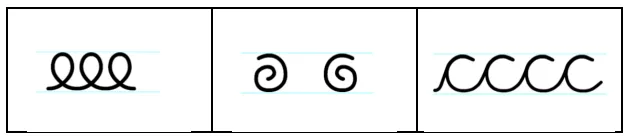
Examples of patterns a year one child could practise:
Most Year Two Children should be able to:
- form lower-case letters of the correct size relative to one another;
- start using some of the diagonal and horizontal strokes needed to join letters;
- understand which letters, when adjacent to one another, are best left unjoined;
- write capital letters and digits of the correct size, orientation and relationship to one another and to lower case letters;
- use spacing between words that reflects the size of the letters.
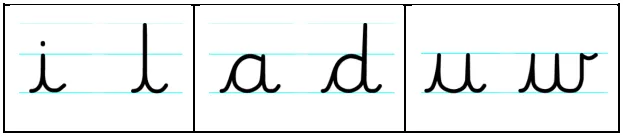
Examples of letters a year one and two child should know ‘easy letters’:
Year 3 and 4 Handwriting Standards at Castle Bromwich Junior School
Most Year Three Children should be able to:
- use the diagonal and horizontal strokes that are needed to join letters and understand which letters, when adjacent to one another, are best left unjoined.
Handwriting examples of Year 3 ‘easy words’:

Most Year Four Children should be able to:
- use the diagonal and horizontal strokes that are needed to join letters and understand which letters, when adjacent to one another, are best left unjoined;
- increase the legibility, consistency and quality of their handwriting [for example, by ensuring that the down strokes of letters are parallel and equidistant; that lines of writing are spaced sufficiently so that the ascenders and descenders of letters do not touch].
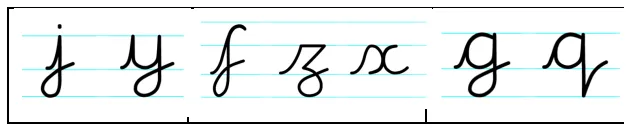
Handwriting examples of Year 4 ‘harder letters’:
Year 5 and 6 Handwriting Standards at Castle Bromwich Junior School
Most Year Five and Six Children should be able to: write legibly, fluently and with increasing speed by:
- choosing which shape of a letter to use when given choices and deciding whether or not to join specific letters;
- choosing the writing implement that is best suited for a task.
Handwriting examples of Year 5 ‘harder words’:

A typical Year 6 child would then focus on any joins that they are still struggling with a particular emphasis on increasing the speed of legible handwriting.
To support your child in school, each week, the children have a handwriting lesson addressing a specific skill or pattern. Within these sessions, a specific join or letter formation is taught and the children develop and practise in their own handwriting books.


